
Europe’s demographic challenge: how to guarantee intergenerational fairness in pensions and beyond
Europe’s ageing population is putting pressure on pension systems and raising a key question: can they remain fair across generations? At a recent GDV event in Brussels, participants agreed the challenge is significant but still manageable, with timely action.
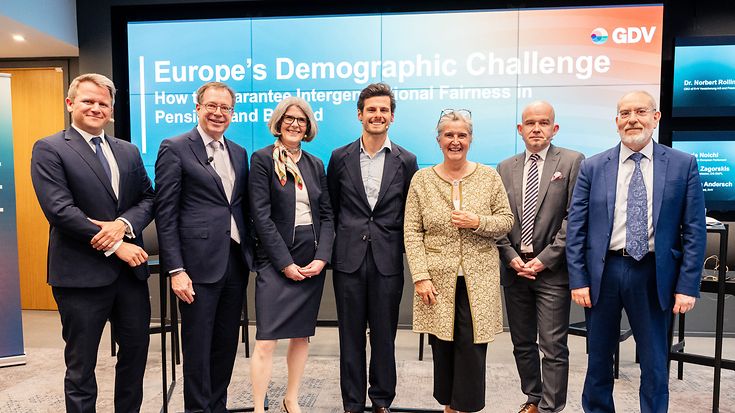
From left to right: Florian Wimber (GDV), Dr. Norbert Rollinger (CEO of R+V Versicherung AG and President of GDV), Claudia Andersch (Member of the Board, R+V), Grégoire Mazy (EU Youth Dialogue and Forum des Jeunes), Maria Noichl (Member of the European Parliament), Valdis Zagorskis (European Commission, DG EMPL), and Pablo Antolin (OECD, Head of Insurance and Pensions)
Engaging younger generations earlier
The core challenge is timing. Pension planning often begins too late, even though early contributions are crucial. Yet for many young people, retirement feels too distant to prioritise.
Speakers highlighted financial literacy and pension awareness as key tools but stressed that education must go hand in hand with practical solutions. Well-designed systems, such as automatic enrolment, can significantly increase participation, while pension tracking tools can help individuals keep oversight in increasingly mobile careers.
Addressing persistent inequalities
Fairness between generations also depends on fairness within them. The gender pension gap remains substantial, driven by unequal pay, career interruptions and the unequal distribution of unpaid care work. This comes on top of social trends such as rising numbers of single mom households. Tackling these structural issues is needed to ensure adequate pensions for all.
Across countries, pension systems face the same challenge: balancing financial sustainability with adequate retirement income. Demographic change has made this more difficult, while longer life expectancy puts pressure on systems designed under different assumptions.
Multi-pillar approaches that combine public, occupational and private pensions, are widely seen as part of the solution. However, these elements must complement each other effectively.
The role of insurance and system design
Insurers play a key role in managing longevity risk and providing stable retirement income. But for systems to work, products must be transparent, easy to understand and comparable.
Transferability is equally important. As careers become more flexible, pension rights must be easier to transfer across jobs and borders.
Rebuilding trust with younger generations
Younger people are entering a more uncertain labour market, with different expectations around work and career paths. While they are increasingly aware of the need for financial planning, many feel their concerns are not sufficiently reflected in policy decisions. Closing this gap is essential to rebuild trust and ensure long-term system stability.
The discussion also underlined that pensions cannot be viewed in isolation. Adequate retirement outcomes depend on wider factors such as access to good jobs, fair wages and inclusive social policies. EU initiatives on financial literacy, labour markets and poverty reduction point in this direction, alongside efforts to strengthen pension systems themselves.
Moving forward
Ensuring intergenerational fairness will require a combination of better education, stronger system design, and continued reform. The tools are available, but time is of the essence. The sooner action is taken, the better the chances of securing sustainable and adequate pensions for future generations.