Simplification with impact: driving Europe’s global leadership
At a time of growing geopolitical uncertainty and economic pressure, GDV Brussels organised an event to discuss how the EU can strengthen its competitiveness and global standing, and how the European simplification approach can help ensure that the European insurers remain world leaders and innovators.
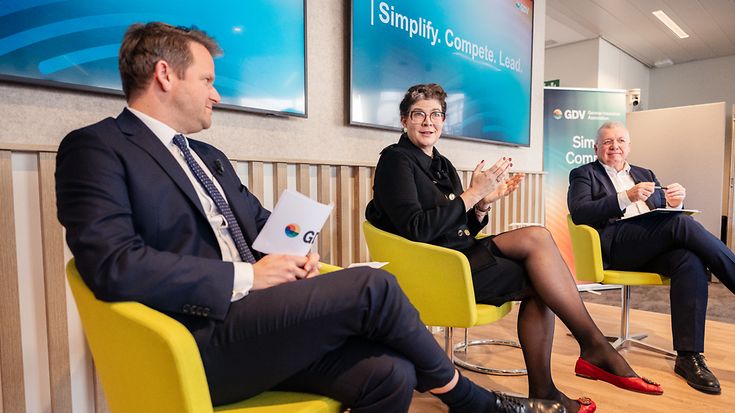
From left to right: Florian Wimber (Head of European and International Affairs, GDV), Irina Buchmann (CFO, AXA Germany), Markus Ferber (Member of the European Parliament)
During the conversation, participants agreed that the EU remains a major economic power, thanks in large part to its Single Market and strong global industries. In particular, the insurance sector stands out as one of Europe’s remaining global success stories, playing a key role in supporting investment, managing risk, and enabling economic activity. However, this position is increasingly challenged by global instability and slow growth. In this context, strengthening the Single Market and reducing internal barriers were identified as key priorities for enhancing Europe’s competitiveness.
Insurance as a strategic pillar of the economy
The speakers dove further into the topic where we learnt more about the continued role of the insurance sector as a crucial pillar of Europe’s economy. By providing risk coverage, supporting investment, and enabling long-term planning, insurers play a stabilising role across economic cycles. This long-term perspective, however, is increasingly strained by an ever-growing set of regulations.
A recurring concern throughout the discussion was the cumulative effect of complex and overlapping regulation. While individual rules may be justified, their combined impact creates significant challenges without clear benefits for consumers. Our speakers pointed to increasing reporting requirements and administrative obligations, which divert resources away from core business activities and ultimately raise costs for policyholders.
From an international perspective, Europe’s regulatory approach appears comparatively burdensome. In other countries, supervisors often place greater emphasis on understanding underlying risks rather than relying on extensive reporting frameworks. This contrast has implications for Europe’s competitiveness, particularly in a global market where capital and business decisions are increasingly mobile.
From simplification to real impact
There was broad support for ongoing simplification efforts, including the European Commission’s omnibus initiatives. However, participants stressed that progress has so far been limited, with simplification in some areas replaced by new requirements in others.
In terms of next steps, our guests emphasised the need to focus on what is truly necessary and effective. This includes avoiding new regulatory initiatives that do not address clear problems, streamlining existing frameworks, and ensuring consistent supervision across EU countries. Making sure rules are applied consistently and that authorities work better together was seen as just as important as cutting back on the number of rules.
Finally, the discussion pointed out that the EU’s competitiveness will depend not only on the strength of its industries, but also on the rules that regulate them. Simplification, if done right, can free up capacity for investment, innovation and growth. This would help Europe turn current challenges into an opportunity for renewed global leadership.