From risk to readiness: advancing climate resilience in Europe
As climate risks are becoming more frequent, more severe and harder to ignore, GDV Brussels organised a high-level breakfast discussion on how Europe can strengthen climate resilience and improve protection against natural catastrophes. For the German insurance industry, climate resilience is a core priority. Our event brought together policymakers and industry representatives to discuss how a future European framework can balance climate adaptation and mitigation. The solution must combine affordability, solidarity, awareness, and preparedness.
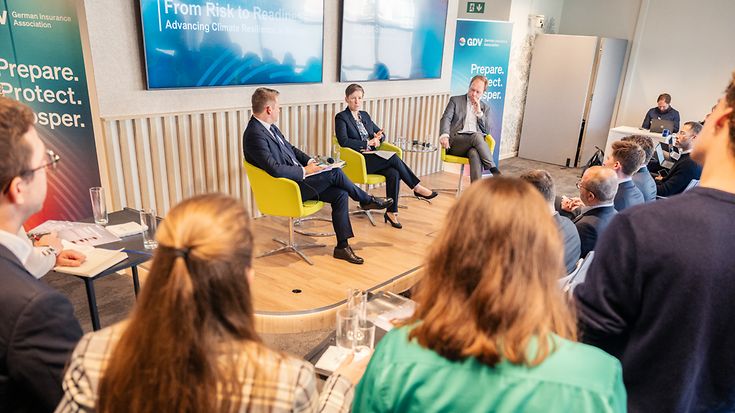
Speakers, from left to right: Florian Wimber (GDV), Kurt Vandenberghe (European Commission), and Sibylle Steimen (Allianz Re)
The discussion focused on the growing urgency of prevention and adaptation. The speakers emphasised that climate change itself is not new, nor is mitigation as a policy objective. What has changed is the level of evidence, the visible impact across Europe, and the growing recognition that current systems are not sufficiently prepared for what lies ahead.
From adaptation to preparedness
A central theme of the discussion was the shift in mindset that has taken place in recent years. For a long time, climate debates focused primarily on mitigation. Today, while mitigation remains essential, there is a growing recognition that adaptation can no longer be treated as secondary. Europe must prepare not only for the climate it hopes to avoid, but also for the climate it is already beginning to experience. Droughts, floods, and other extreme events are becoming part of Europe’s new normal, with consequences for public health, infrastructure, businesses, and households alike.
In this context, the forthcoming European climate resilience framework was presented as an important opportunity to strengthen preparedness and improve how risks are governed. Our speakers stressed that resilience should be understood not simply as reacting to disasters, but as anticipating them earlier, reducing vulnerabilities, and embedding long-term thinking into present-day decisions.
Insurance as an active partner in resilience
The discussion also highlighted the changing role of the insurance sector. Insurers and reinsurers are already on the front line of climate data collection and have significantly expanded their expertise in recent years. By helping identify, assess and understand price risks, the sector can play a key role in strengthening awareness, preparedness, and better decision-making. Digital tools, improved risk modelling, and more tailored insurance solutions were all mentioned as ways to support households, businesses and public authorities in adapting to a changing climate.
At the same time, participants made clear that insurance cannot solve the challenges alone. Closing the protection gap requires stronger cooperation between public and private actors. While insurers can support risk awareness and help incentivise adaptation, public authorities remain essential when it comes to infrastructure, flood defences, building standards and long-term planning. Risk ownership and accountability therefore need to be strengthened at all levels: local, regional, national, and European.
Turning awareness into action
A recurring message throughout the discussion was that resilience depends not only on technical solutions, but also on awareness and governance. Too often, citizens and businesses still underestimate their exposure to climate risks or postpone taking preventive action. Making data and risk information more accessible and more meaningful for everyday decisions will therefore be crucial.
Participants also emphasised that climate resilience should not be seen only as a protective measure, but as an investment in Europe’s future. A stronger framework for preparedness can help reduce future losses, support innovation and mobilise investment in solutions that make societies more resilient. If done right, this would not only improve protection against natural catastrophe risks but also strengthen Europe’s long-term competitiveness in a changing climate.