Five years after the Ahr Valley floods: Insurers warn against a false sense of security
Five years after the devastating floods in Germany's Ahr Valley, the GDV warns against viewing the July 2021 disaster as an isolated regional event. Similar extreme weather events could strike other parts of Germany at any time. Insurers have settled claims totalling around €8.75 billion in the affected areas. The GDV is calling for faster progress on prevention, flood protection and climate adaptation.
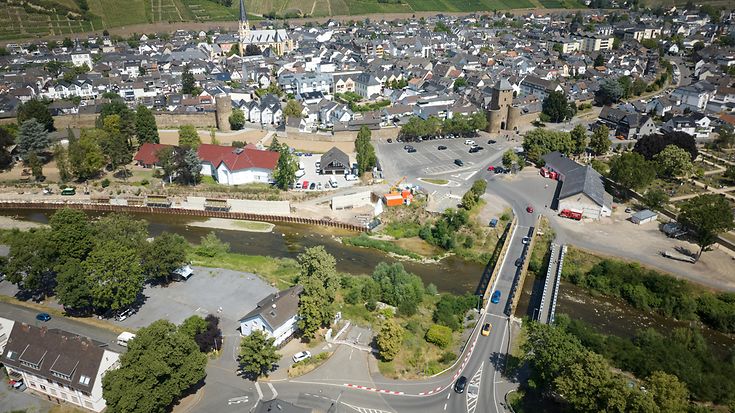
View of Ahrweiler around five years after the flood: in the foreground, the temporary bridge replacing the Ahrtor Bridge.
"Our thoughts are with the people who lost their lives in the floods and with their families. Their suffering compels us to do everything we can to prevent such a catastrophe from happening again," said Jörg Asmussen, CEO of GDV. "Germany must invest more quickly in prevention and climate adaptation. The next extreme weather disaster will not wait until protection measures have been planned, approved and built."
Flood protection must be accelerated
Since the floods, the district of Ahrweiler has upgraded warning systems, rebuilt bridges, and widened and restored river channels. At the same time, the reconstruction effort highlights how long it takes to implement effective flood protection. Major flood retention basins and additional retention areas require years to complete and, in many cases, can only be realized with financial support from the federal and state governments.
"Preparedness must not be limited to regions that have already experienced a disaster. Other valleys and smaller catchment areas in Germany's low mountain ranges, such as those along the Kocher, Oker, Volme and Weißeritz rivers, could also be severely affected under similar weather conditions. Action is needed today, not after the next flood," Asmussen said.
Natural catastrophe losses and insurance coverage
Natural catastrophe caused around €1.4 billion in insured property losses in 2025. Of this total, approximately €400 million resulted from flooding and heavy rainfall. In 2024, insured losses reached €4.7 billion, including €2.8 billion from natural catastrophes and €1.9 billion from storms and hail.
Since the GDV began collecting data in 2002, natural catastrophe losses have averaged around €2 billion per year. Even excluding the Ahr Valley floods, the annual average remains around €1.5 billion. Relatively quiet years, such as 2025, should therefore not be mistaken for an all-clear.
Damage caused by storms and hail is generally covered automatically under German residential building insurance. However, losses resulting from flooding, heavy rainfall and other natural catastrophes require additional insurance cover. At the end of 2025, around 59% of residential buildings in Germany were insured against natural catastrophes.
Coverage has increased particularly sharply in the states most affected by the 2021 floods. In North Rhine-Westphalia, the share of residential buildings with natural catastrophe cover rose from 47% in 2020 to 65% by the end of 2025. In Rhineland-Palatinate, it increased from 37% before the floods to 59% by the end of 2025.
Debate on mandatory natural catastrophe insurance
In the GDV's view, mandatory natural catastrophe insurance on its own is not enough. While it would increase insurance penetration, it would not address key issues such as prevention, high-risk properties or the financing of exceptionally severe disasters. Instead, a comprehensive approach is needed.
The GDV proposes making natural catastrophe cover the default option within residential building insurance, while allowing policyholders to opt out. At the same time, Germany needs greater investment in prevention, climate-resilient construction and property-level flood protection. New residential developments should not be built in provisionally secured or officially designated flood-prone areas. In addition, exceptionally severe natural disasters require a clearly defined government backstop.
Through its Elementar Re proposal, the German insurance industry has presented a technical framework for such a system. The GDV is also advocating the creation of a nationwide natural catastrophes portal that could serve as a transparent tracker of climate adaptation measures. It should show which protection projects are planned, funded, under construction or completed. Homeowners who want to better assess their own exposure can use the GDV's Flood Check to obtain address-specific assessments of flood and heavy rainfall risk.