Property insurance: Natural hazards caused €1.4 billion in damage in 2025
GDV presented new figures on natural catastrophe losses in property insurance. After the loss-heavy previous year, 2025 was significantly more moderate. The year was primarily characterized by storms and hail.
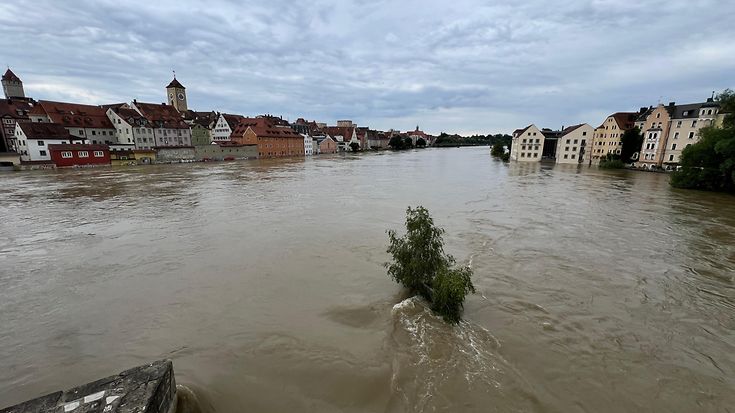
Powerful swirling currents in a flooded river in Regensburg in the summer of 2024.
“Natural catastrophes caused around €1.4 billion in damage in property insurance in 2025. Losses fluctuate greatly from year to year, so quieter years should not be interpreted as a trend,” says GDV CEO Jörg Asmussen.
Storms and hail cause the most damage
Storms and hail caused losses of around €1 billion. The number of claims was about 479,000, with an average loss of roughly €2,100.
Thus, even in a comparatively calm natural catastrophe year, storms and hail dominate the property damage balance. Such events often affect many buildings at once but typically cause smaller to medium-sized damage, for example to roofs, facades, or windows.
Natural catastrophe losses remain particularly costly
Insured natural catastrophe losses (excluding storm and hail) totaled around €400 million in 2025 across approximately 88,000 claims. With an average of about €4,700 per claim, costs are significantly higher than for storms and hail. This difference shows how severe individual flood or heavy rainfall losses can be and why coverage is advisable.
No all-clear despite a quieter year
The decline in 2025 by around €3 billion is mainly due to the loss-heavy previous year. In 2024, insured natural catastrophe losses in property insurance amounted to €4.4 billion, including €2.6 billion from natural catastrophes (excluding storm and hail) and €1.8 billion from storms and hail.
Since records began in 2002, natural catastrophe losses (excluding storm and hail) have cost insurers an average of €2 billion annually. Even without the flash flood in the Ahr Valley in 2021, the average still stands at €1.5 billion.
The current “European State of the Climate Report 2025” also shows why lower losses should not be confused with declining risks: Europe has been warming about twice as fast as the global average since the 1980s. In 2025, temperatures were above average across more than 95 percent of the area. At the same time, heatwaves are increasing, glaciers continue to lose mass, and heavy rainfall events are becoming more frequent and intense. The year 2025 is therefore only a snapshot.
Germany is insufficiently insured
In residential building insurance, damage caused by storms and hail is usually automatically covered. However, coverage for floods, heavy rainfall, and other natural catastrophes requires an additional component, which in 2025 was included in only around 59 percent of residential buildings in Germany.
Many homes are therefore still not comprehensively protected against natural catastrophes, even though insurance coverage is generally available for almost all buildings. Since 2000, around 1,000 to 2,400 new residential buildings have been constructed each year in designated flood-prone areas. At the same time, many existing buildings are not structurally prepared for heavy rainfall and flooding. Regulations on construction planning, risk assessments, and protection levels are still not consistently implemented in many federal states and municipalities.
Insurance coverage is a key component, but growing risks require an overall concept combining prevention, government responsibility, and insurance. In addition, new construction in flood-prone areas should no longer be approved in the future.
A dedicated system instead of simple transfer
A look at international models such as France shows that solutions from other countries cannot simply be transferred one-to-one to Germany. The French system provides only limited incentives for prevention, is under financial pressure, and is financed through cross-subsidization.
Germany needs its own viable system for dealing with natural catastrophes. The focus should be on an overall concept in which prevention, government responsibility, and insurance interact reliably. Only in this way can risks remain insurable in the long term and damages for citizens, businesses, and the state be limited.
Flood check helps assess risk
Anyone who wants to understand their risk from river flooding and heavy rainfall can use the GDV’s flood check. This free online tool shows the risk situation for specific addresses and provides initial guidance for prevention and insurance coverage.