
Wiens and Hielkema: the supervisory perspective
At the GDV Conference on Insurance Regulation, Julia Wiens, Executive Director for Insurance and Pension Fund Supervision at BaFin, and Petra Hielkema, Chair of the European Insurance and Occupational Pensions Authority (EIOPA), outlined how the regulatory framework for insurers is evolving from both national and European perspectives.
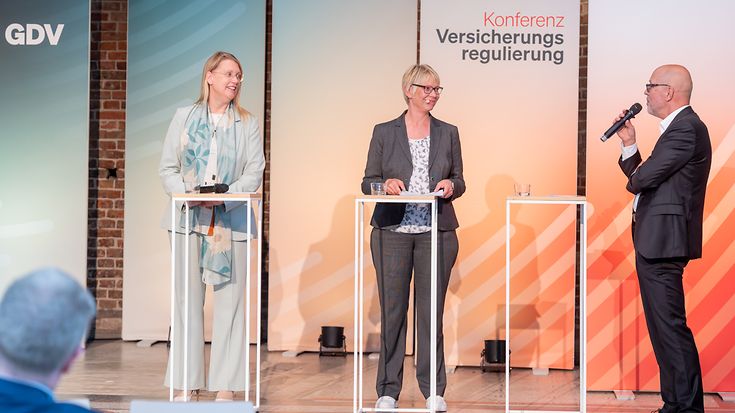
BaFin Executive Director Julia Wiens and EIOPA Chairwoman Petra Hielkema in conversation with GDV CEO Jörg Asmussen at the GDV Conference on Insurance Regulation.
In an environment marked by geopolitical upheaval, volatile markets, and economic uncertainty, both speakers emphasized the importance of stability and trust. A common theme throughout their presentations was the goal of ensuring that regulation remains effective while imposing only a proportionate administrative burden. Regulation should be stringent where necessary, particularly regarding capital requirements, while remaining practical and proportionate in its application.
Wiens: proportionality without compromising safety
Julia Wiens made proportionality the central theme of her remarks. Small and medium-sized insurers, she argued, should not be subject to the same requirements as large insurance groups.
As part of the Solvency II review, thresholds have been increased, meaning that from January 2027 fewer companies will fall within the scope of Solvency II. Those firms will instead be subject to the lighter Solvency I regime and will be exempt from the Digital Operational Resilience Act (DORA).
Even within Solvency II, a more differentiated approach will apply: Small and Non-Complex Undertakings (SNCUs) will be able to benefit directly from ten simplification measures. Non-SNCUs may access up to seven simplifications subject to supervisory approval. Large insurers will generally not be eligible for these measures.
Wiens rejected calls for an insurance-sector equivalent of the simplified regime being discussed for small banks. While such a regime would involve simpler rules, it would also require significantly higher capital levels.
Implementation will begin well before the new rules formally enter into force. From 1 August onward, insurers will be able to use a pre-notification and pre-application process to obtain an initial assessment of their future classification before the revised framework takes effect on 30 January 2027.
A key message from Wiens was that capital requirements should not be weakened, especially in uncertain times. She strongly supports the Solvency II review because it improves the risk sensitivity of interest-rate risk calculations. While insurers can expect a meaningful reduction in capital requirements overall, this will only be true “on average.” Individual firms will still need to assess their actual risk exposures carefully and maintain adequate buffers.
IRRD and fair pricing
Wiens also addressed the Insurance Recovery and Resolution Directive (IRRD), which is being transposed into German law through the VSAAG legislation.
Unlike the life and health insurance sectors, Germany currently lacks a protection fund for distressed non-life insurers. BaFin therefore supports the creation of such a fund to safeguard insurance claims and pension entitlements.
Both the Directive and its German implementation have been designed with proportionality in mind: Insurers representing at least 60% of market share will be required to prepare recovery plans. Insurers representing at least 40% of market share will be subject to resolution planning requirements.
Wiens devoted significant attention to conduct supervision in the non-life insurance sector.
While insurers enjoy pricing freedom, this does not mean that “anything goes.” Premiums must be risk-based and may not be excessive. A recent survey found that 85% of insurers apply additional pricing differentiation in motor insurance products outside their formal pricing models.
Wiens expressed concern about non-risk-based discounts of up to 80% and about “price walking”, the practice of gradually increasing premiums for existing customers, often affecting older or less digitally savvy consumers.
She stressed that the objective is not price regulation, but rather identifying and addressing unfair practices and “bad actors.”
BaFin will also closely monitor the distribution of the reformed subsidized pension products. Sales strategies driven solely by commission incentives will not be acceptable; customer needs must remain the determining factor.
Hielkema: stability and trust in a volatile world
Petra Hielkema complemented the discussion with the European perspective.
She described the current macroeconomic environment as fragile, volatile, and uncertain. Geopolitical alliances, supply chains, and trade relationships are being reshaped. Against this backdrop, stability is essential ;not as a synonym for stagnation, but as the ability to withstand and adapt to crises.
According to Hielkema, the risk-based Solvency II framework has proven its value through multiple periods of stress, from the prolonged low-interest-rate environment to the unexpected inflation shock. The current review does not alter that fundamental approach but rather refines specific elements of the framework.
She highlighted the scale of the reporting burden reductions: Quarterly reporting templates will be reduced by 26% for solo entities and 36% for small and non-complex undertakings. Annual reporting templates will be reduced by 30% and 40%, respectively. Overall reporting data points will decrease by 22%.
These simplifications, she emphasized, are being achieved without weakening policyholder protection or financial stability. More extensive reductions would not be advisable.
The capital relief resulting from changes to the risk margin, volatility adjustment, and the treatment of long-term equity investments and securitizations comes with a clear policy expectation: the capital released should be invested productively, particularly in infrastructure, the transition to climate neutrality, and digital transformation.
EIOPA has been tasked with monitoring how this capital is used and reporting its findings to the European Commission. A first report is expected in 2028.
IRRD and gaps in consumer protection
The revised Solvency II framework and the IRRD will both come into effect on 1 January 2027.
Hielkema noted that no regulatory framework, however well designed, can eliminate all insurer failures. A dedicated recovery and resolution framework tailored to insurers is therefore necessary to limit losses and prevent contagion effects.
EIOPA is currently finalizing the supporting measures and intends to work with national supervisory authorities to ensure implementation is gradual and proportionate.
Hielkema also highlighted what she sees as a significant remaining gap in the European framework. While the single market for insurers is becoming increasingly integrated, consumer protection remains fragmented.
Policyholders enjoy very different levels of protection depending on where they live. Some Member States have robust guarantee schemes, while others have only limited protection, or none at all.
This fragmentation, she argued, creates a fundamental inequality and undermines consumer confidence. Insurance remains the only major retail financial sector in Europe without a minimum level of harmonization for guarantee schemes at EU level.
Hielkema concluded by emphasizing that trust cannot be taken for granted, it must be earned through products that deliver on their promises, strong consumer protection, and clear, consistently applied rules.
The overarching objective, she said, is to create an “island of certainty” for consumers and the financial system, even in an increasingly uncertain world.
Discussion with Jörg Asmussen
Following their presentations, Julia Wiens and Petra Hielkema joined GDV CEO Jörg Asmussen for a discussion that brought together the perspectives of national supervisors, European supervisors, and the insurance industry.