
Jour-Schröder: Mobilizing European capital to strengthen competitiveness
In a discussion with Götz Treber, Head of Corporate Governance and Regulation at GDV, Alexandra Jour-Schröder, Deputy Director-General of the European Commission’s DG for Financial Stability, Financial Services and Capital Markets Union (DG FISMA), outlined the Commission’s priorities for building a more competitive European financial sector at the GDV Insurance Regulation Conference.
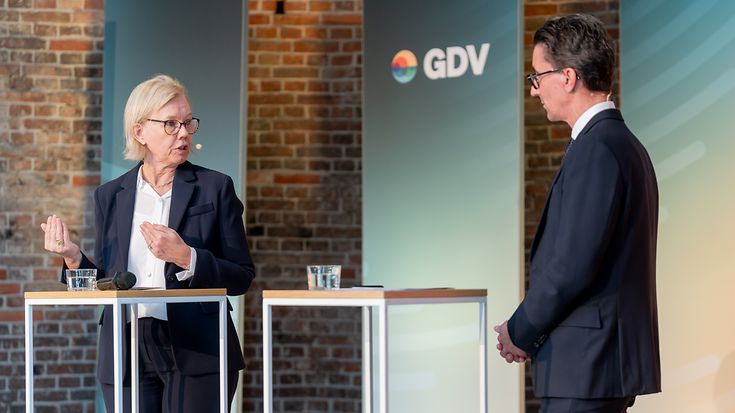
Alexandra Jour-Schröder, Deputy Director-General at the European Commission (FISMA), in conversation with Götz Treber, Head of Centre of Competence Corporate Management and Regulation at the GDV.
In a discussion with Götz Treber, Head of Corporate Governance and Regulation at the German Insurance Association (GDV), Alexandra Jour-Schröder, Deputy Director-General of the European Commission’s Directorate-General for Financial Stability, Financial Services and Capital Markets Union (DG FISMA), outlined the Commission’s priorities for building a more competitive European financial sector at the GDV Brussels Insurance Regulation Conference.
According to Jour-Schröder, the guiding question behind her work is straightforward: How can Europe become more competitive again, and what role can the financial sector play in achieving that goal? Insurers, she stressed, have a key role to play.
Savings and Investment Union: a simple idea, difficult to implement
The concept of the Savings and Investment Union is simple in principle but challenging in practice. Europe needs substantially more investment, in businesses, digital technologies, defense, and green projects. The critical question is how to mobilize private capital to finance these priorities.
Capital markets are central to this effort. Europe’s capital markets remain fragmented and cannot yet compete with large, unified markets such as the New York Stock Exchange. The core problem is the existence of too many small trading venues. The objective is therefore to create a more integrated system through harmonized rules, including directly applicable EU regulations, and by simplifying reporting requirements.
However, Jour-Schröder cautioned against calls to eliminate reporting obligations altogether. Many reporting requirements serve a legitimate purpose. Instead, efforts should focus on identifying overlaps; for example, whether information already reported in one context really needs to be reported again elsewhere, or whether data-sharing mechanisms could be used instead.
The debate, she argued, should not be framed as “reporting requirements are simply bad,” but should examine each requirement on its merits. Treber agreed, emphasizing that the goal is not to abolish regulation indiscriminately but to improve it and remove rules that do not deliver meaningful outcomes.
European supervision: more analysis needed before decisions are made
A sensitive but important issue is whether supervisory powers should be strengthened at the European level, particularly for firms operating across borders. The EU has already decided to grant the European Securities and Markets Authority (ESMA) greater responsibilities in supervising capital markets.
Jour-Schröder firmly rejected applying the same approach automatically to the insurance sector, calling such a move “simply irresponsible.” Before any decision is taken, the specific characteristics of the insurance industry must be carefully analyzed.
Treber reiterated the GDV’s position that there is no business case for further centralization and that the current system of national supervisory authorities works well. Jour-Schröder confirmed that extending this model to insurance supervision is currently “not on the radar.”
Solvency II as a test case for greater investment
The recent Solvency II review reduced certain capital requirements, which Jour-Schröder described as a “significant step forward,” particularly in facilitating long-term equity investments.
As the revised framework will only come into force next year, it will serve as a test case demonstrating how the insurance industry uses these new opportunities, especially in venture capital and private equity investments, always in cooperation with supervisors.
Asked about Germany’s WIN initiative and France’s Tibi initiative, she praised both as positive—though different—approaches. She also highlighted a largely overlooked feature of the Solvency II delegated regulation: where investments are made jointly with a public institution—such as Germany’s KfW development bank—equity investments may receive more favorable regulatory treatment.
Importantly, this does not require a government subsidy. It is sufficient that both public and private capital are invested alongside one another.
Tax and insolvency law: important but not immediate priorities
Jour-Schröder was more skeptical regarding harmonization of tax and insolvency laws. While both are important issues, time and political realities make progress difficult.
Efforts to harmonize insolvency law have repeatedly failed because of the deep differences between national legal systems and their historical development. She did not consider the issue closed, but argued that priorities should focus on areas where tangible progress is achievable—particularly in financial services, where there is currently strong political momentum.
When Treber raised the idea of a “28th regime” (an optional EU-wide legal framework for companies), Jour-Schröder responded positively. The Commission is working closely with the Directorate-General for Justice and has strongly supported the initiative.
The regime would cover the entire corporate lifecycle—from company formation onward—and would be available as an option rather than a mandatory framework. She described it as a “very smart idea.”
Financial Services Omnibus: not a silver bullet
When asked whether a broad Financial Services Omnibus package would be useful, Jour-Schröder urged caution.
What matters, she said, is not the legislative vehicle but the substance. The Omnibus approach was originally developed to ease sustainability reporting requirements under significant time pressure and worked well in that context. However, it cannot simply be transferred to financial services.
The sector has already seen numerous simplification measures, including in sustainable finance regulation and Solvency II. An omnibus package is therefore “not the ultimate solution,” although it remains part of the ongoing discussion.
Stop the clock: prefer dialogue over delays
On calls to “stop the clock” and delay implementation of the Insurance Recovery and Resolution Directive (IRRD), Jour-Schröder took a clear position: she does not believe the directive is a good candidate for postponement.
The implementation deadline is already running, and Germany has begun transposing the rules into national law. She acknowledged industry concerns, particularly because this is the first time such a recovery and resolution framework has been established for the European insurance sector.
Nevertheless, she argued that it is unrealistic to expect everything to work perfectly from day one. Rather than taking a rigid, formalistic approach, the Commission intends to work collaboratively with the industry, Member States, and the European Insurance and Occupational Pensions Authority (EIOPA) to address implementation issues through ongoing dialogue.