
Private funding for public infrastructure: How institutional investors can contribute to a resilient Europe
Both Germany and Europe currently face significant infrastructure challenges, from ageing bridges to schools and rail systems. With public budgets under pressure across Member States, innovative financing models are essential. Institutional investors – such as insurers – can play a pivotal role in bridging this gap.
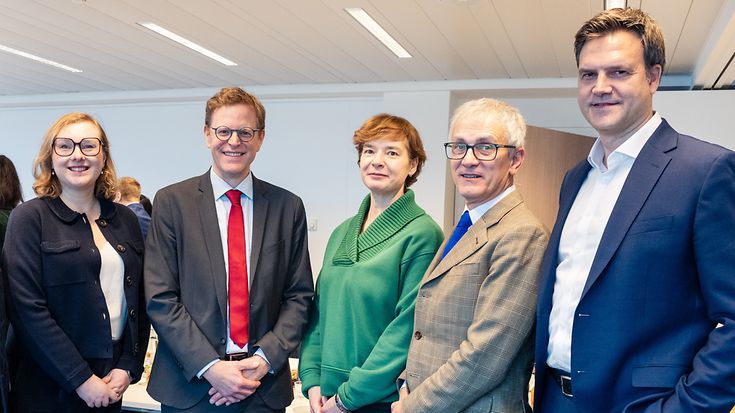
From left to right: Marija Ivoninaite, Philippe Chantraine, Sandra Parthie, Alberto Mazzola, Tim Ockenga
Against this background, GDV hosted a breakfast roundtable in partnership with the German Economic Institute to explore how public–private partnerships (PPPs) can accelerate modernization of Europe’s infrastructure – in areas ranging from transport to energy grids. Dr. Markus Demary, Senior Economist for Monetary and Financial Markets at the German Economic Institute, presented preliminary findings of an upcoming study commissioned by GDV on this important model for financing infrastructure projects.
In the discussion that followed, Philippe Chantraine, Head of Unit for Transport Investment at the European Commission’s DG MOVE, Alberto Mazzola, Executive Director of the Community of European Railway & Infrastructure Companies (CER), and Tim Ockenga, GDV’s Head of Investments, highlighted both the opportunities of the PPP model as well as obstacles to using it more widely in Europe.
PPPs can outperform conventional procurement
Participants agreed that if designed well, including appropriate risk-sharing mechanisms, PPPs can outperform conventional procurement for large, complex projects through cost savings, lifecycle benefits, and efficiency gains. This applies to both to conventional projects for roads and public buildingsas well as projects related to the green transition.
Due to the long-term nature of their business, insurers are natural partners for funding infrastructure projects. This is illustrated by the German industry, which has close to 6% of their total assets invested in infrastructure, amounting to more than EUR 110 billion at the end of 2024. According to Tim Ockenga, there is appetite to expand this further if more viable projects with attractive conditions emerge.
Looking ahead, PPPs could be harnessed better to meet Europe’s investment needs in infrastructure through learning from best practice examples across Member States and sectors, as well as targeted regulatory changes to remove remaining barriers to involving private investors. Other suggestions that were raised included bundling smaller projects at the municipal level, reviewing the relevant policies of European development banks and developing standardised PPP contracts that could be deployed more widely.