
Beyond Solvency II: Risk, Resilience, Insurance
At a recent GDV event in Brussels, policymakers, regulatory experts, and insurance specialists reflected on what Solvency II has achieved, where challenges remain, and how regulation can continue to support a resilient and competitive European insurance sector.
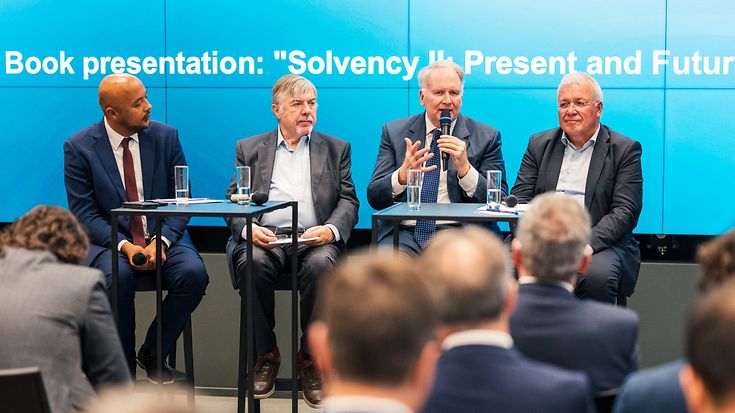
Panellists, from left to right: Elias Hartmann (GDV), Prof. Karel van Hulle (KU Leuven, Goethe University Frankfurt), Prof. Christian Thimann (Goethe University Frankfurt), Markus Ferber (Member of the European Parliament)
Resilience while allowing insurers to take risk
A central theme of the discussion was balancing insurance regulation: Solvency II provides assurance that insurers can meet their commitments, but regulation must also allow them to take and manage risk. Removing risk entirely would limit the ability of insurers to respond to the needs of households, businesses, and society at large.
The participants agreed on Solvency II’s role as a global benchmark for insurance regulation, while raising concerns about the increasing complexity of the framework. A renewed focus on the basic principles could help make the framework more workable without losing its focus on resilience.
This balance is particularly important because of the distinctive role insurance plays in the economy. Policyholders need confidence that insurers will still be there when claims or long-term commitments are due. At the same time, insurers must also be able to grow, invest, and respond to new risks.
Unlocking the potential of long-term investment
The role of insurers as long-term investors was another important theme. They can provide capital for investments with long time horizons, for example in infrastructure. Participants welcomed progress towards releasing capital for investment, while stressing that implementation, including consistent application by supervisors, will be important.
When it comes to supporting the European economy, there is also a need to distinguish insurers, as long-term investors, from banks, who can provide short-term investments. Making sure that regulation allows insurers to fulfil their role is therefore important for the goal of mobilising capital. In this context, the speakers emphasised the need to extend the simplification efforts from banking into insurance. More specifically, speakers called for a Financial Services Omnibus for the insurance sector, to address unnecessary regulatory complexity while supporting competitiveness and insurers’ ability to continue long-term investments.
On the liability side, the speakers pointed to another challenge: the declining provision of long-term guarantees. Finding an economically sound way to enable insurers to offer such guarantees again could become increasingly relevant as Europe confronts challenges around pensions, health, and natural catastrophes.
Keeping Europe competitive
Competitiveness was a recurring theme throughout the discussion. Participants stressed that prudential regulation should not be considered in isolation from Europe’s ability to compete internationally.
Solvency II itself was developed with competitiveness and growth among its objectives. It is important to look beyond the EU and learn from approaches taken in other insurance markets, including the UK and the US. This does not mean that regulation needs to be identical everywhere. Rather, proportionality and an openness to different approaches can help preserve the advantages of a common framework while recognising the needs of individual markets.
Europe continues to have world-leading insurance companies, but participants warned that weaknesses in areas such as investment returns could put European institutions at a disadvantage if competitiveness is not sufficiently considered by policymakers.
Moving beyond Solvency II
After a decade of Solvency II application, the discussion showed that the question is no longer simply whether the framework has strengthened resilience. The challenge ahead is how to preserve that resilience while ensuring that regulation remains proportionate, enables long-term investment and allows European insurers to compete internationally.
As new risks and societal challenges emerge, the framework will continue to evolve. The experience accumulated over the past ten years provides an opportunity to learn from what has worked.
The discussion accompanied the launch of a new book: “Solvency II: Present and Future,” published by Oxford University Press. Across 22 chapters, the book examines the framework from different perspectives, including quantitative requirements, risk management, governance, sustainability, public disclosure, and cross-border insurance groups.