
Closing the Pension Gap & Investing in Europe’s Future
The GDV co-hosted with the European Parliament’s ‘Investment for a Competitive and Sustainable EU Intergroup’ an event in the European Parliament titled “Closing the Pension Gap & Investing in Europe’s Future”.
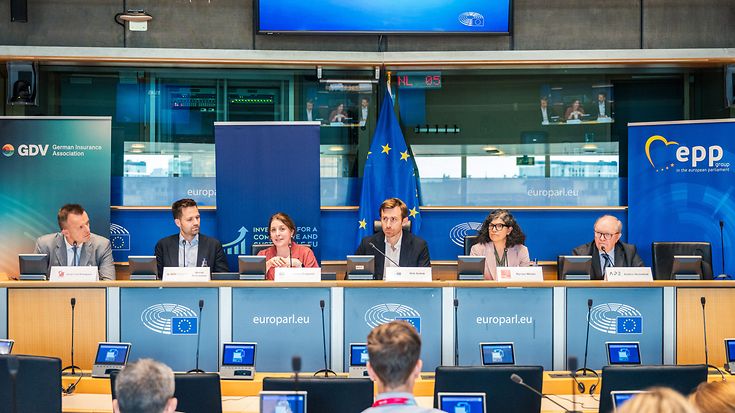
From left to right: Jacob Funk Kirkegaard (Bruegel), Moritz Schumann (GDV), Larisa Dragomir (European Commission), Dirk Gotink (European Parliament), Myriam Métais (Groupe Caisse des Dépôts), and Anders Strömblad (AP2)
The event was hosted by Dutch MEP Dirk Gotink, who is the shadow rapporteur from the Renew Europe faction for the ongoing IORP II Review. As an active member of the Intergroup, the GDV is delighted to have been represented in the event’s panel discussion by GDV Deputy CEO Moritz Schumann. The event’s discussions underlined the vital role that insurance companies with their long-term investment expertise can play in securing effective and sustainable pension systems.
During her keynote speech, Larisa Dragomir, Cabinet Expert on Pensions of Commissioner Albuquerque, warned that demographic change is widening the pension gap across Europe. Whilst she stressed that pillar one pensions remain a Member State competence and should continue to be the backbone of old age-provision, Ms Dragomir made a case for the importance of the Commission’s November 2025 supplementary pensions package that aims to support Member State’s endeavours to future-proof their national pension systems.
In the panel discussion, Mr Schumann argued that Europe needs three strong pillars: a state pension, occupational provision built with employers and social partners, and third pillar private savings. Especially the first two pillars should be made up of standardised products and benefits, while the third should offer greater options for individualisation.
Gotink MEP was candid in his assessment that pension funds thus far invest outside Europe for a reason: the continent lacks the financial infrastructure to generate the returns its retirement systems require. That dependence is difficult to sustain over the long term. Building a more competitive financial infrastructure is ultimately a question of strategic autonomy, not only an economic imperative. Europe must innovate and create opportunities to enable earning money through finance on a large scale.
Speaking on the potential for investments in private assets and venture capital, Mr Schumann argued that the first step at the EU level should be to strengthen European infrastructure capable of absorbing long-term investment, with insurers' general accounts particularly well suited for this task. Only then should policymakers turn to the question of increasing exposure to higher-risk assets. Anders Strömblad of Sweden's AP2 fund agreed, arguing that private investments are a marathon rather than a sprint, requiring stringent, board-controlled strategies, and extensive risk assessments.
In closing our joint event the audience was reminded that pensions are not an ordinary investment; they are, in fact, people's money and not Europe’s. All European savers must be able to trust that their invested money will be there for them once they retire. To do this, Europe does not need to reinvent the wheel, but can learn from successful Nordic examples when creating effective, sustainable, and trustworthy pension systems across the continent.